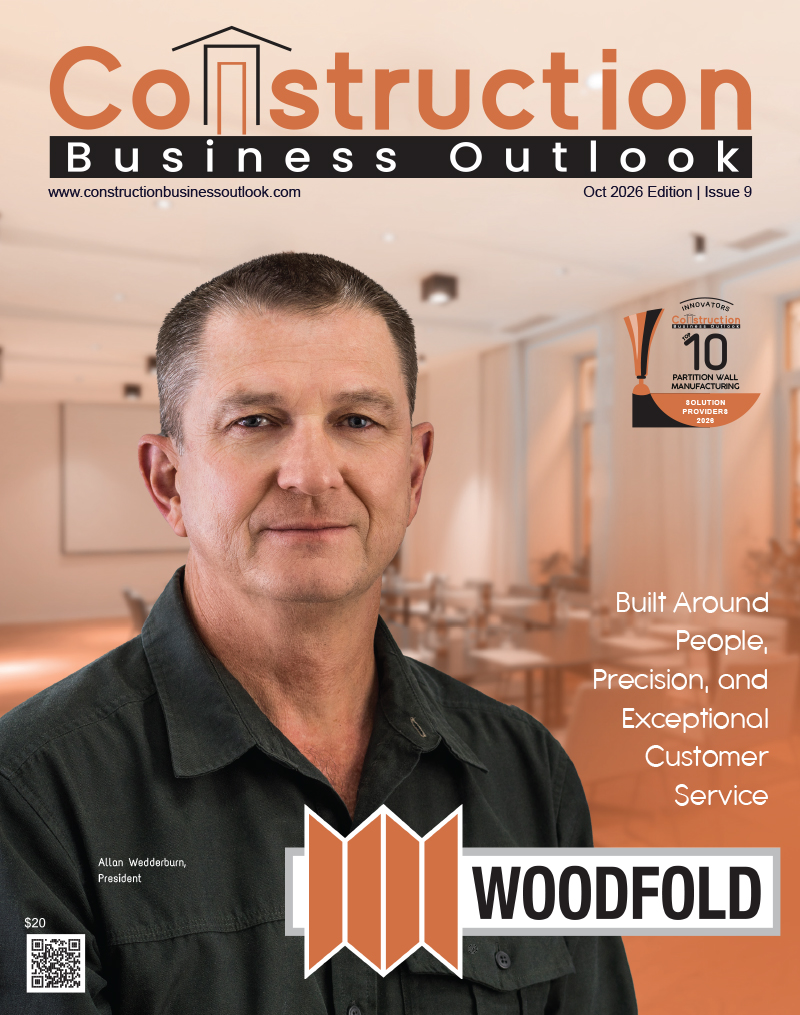
Some products solve a problem so effectively that they remain relevant for generations. Woodfold Manufacturing has built its business around one such idea: making space work better. Since 1957, the company has developed and manufactured custom space-division and specialty door solutions, combining practical engineering with the flexibility of made-to-order manufacturing. Based in Forest Grove, Oregon, Woodfold serves customers through a dealer network and OEM’s while maintaining a distinctly hands-on approach to product development, manufacturing, and customer service.
At the center of the company is a culture shaped by employee ownership. Woodfold Manufacturing’s President Allan Wedderburn sees the employee-owned structure as more than an ownership model; it is an important part of how people approach their work. “We're an employee-owned company, so we use that really as a depiction of the culture,” he says. The result is a manufacturing environment where quality, cost, and delivery remain fundamental measures, but where employees are also trusted to make decisions and respond to the needs of individual projects. In fact, Woodfold’s manufacturing process reflects that balance between systems and people. The company has invested in processes, plant layout, material flow, and equipment to create consistency and efficiency, but does not attempt to remove human judgment from production. Collaboration therefore becomes an essential part of maintaining quality, particularly because Woodfold does not operate around mass-produced finished goods.
Every project is custom-built. Rather than manufacturing products for stock and waiting for an order, Woodfold builds according to the requirements of each customer and opening. “Everything we make is custom-built, so there's nothing we manufacture that goes into stock or finished goods,” says Wedderburn. This model gives customers considerable flexibility in dimensions, materials, finishes, and applications while allowing Woodfold to respond to architectural and functional requirements that standard products cannot easily accommodate. Moreover, their product heritage began with accordion doors, and the category remains central to its identity. Unlike conventional swinging doors, accordion partitions can close or divide spaces without requiring the same amount of clearance. They can help organizations use available square footage more efficiently while maintaining an appearance suited to contemporary interiors. Woodfold has continued refining the category with updated finishes, materials, engineering, and applications rather than allowing a long-established product to become visually or technically dated.
That evolution is important in a market where appearance can be as significant as function. Wedderburn notes that one of the challenges of manufacturing a product with a long history is ensuring that it does not look like a product from decades ago. The company watches changes in architectural and interior-design preferences, including color trends, while remaining responsive to customer requests. Customers can choose from a large selection of finishes or request color matching, giving the products the ability to complement a broader range of environments.
Woodfold’s capabilities extend beyond traditional accordion doors. Its portfolio includes acoustic accordion partitions, security doors, residential elevator accordion doors, solid hardwood roll-up doors, and other specialty products. The company has also expanded its intellectual-property portfolio through strategic acquisitions. Woodfold acquired the intellectual property associated with Panelfold—an interior space division provider—accordion-door line when Panelfold ceased operations. It also entered into an Asset Purchase and OEM agreement with Hufcor—a mobile partition wall provider—for accordion doors. Following Hufcor’s subsequent receivership and closure, Woodfold retained the intellectual property associated with the accordion partition side of the business while another company acquired the operable-wall portion.
Continuous improvement remains part of the company’s everyday operating mindset. Woodfold reviews equipment, manufacturing methods, material movement, ergonomics, and capital requirements with the goal of making work safer and more efficient. Investments are considered over both immediate and one-to-three-year horizons, while broader technology trends are monitored for opportunities to improve operations. Technology, including artificial intelligence, is being considered from an employee-support perspective. “We are exploring and using AI to assist employees. We're not using it to replace employees,” Wedderburn says.
As the leader of the company, Wedderburn’s strongest measure of Woodfold’s progress is not a product or piece of equipment. It is the workforce behind them. He points to the company’s decision during COVID not to use the disruption as an opportunity to downsize. Woodfold wanted to retain its employees because their knowledge, commitment, and capability were fundamental to the organization. “I think fostering the culture and giving people that sense of ownership and pride is very rewarding,” Wedderburn says. For him, successful products and innovation are possible only when supported by people who care about the outcome. “It’s just the strength and capability of the employees.”
That connection between people, craftsmanship, responsiveness, and continuous improvement gives Woodfold its distinctive character. The company continues to modernize its equipment, expand its capabilities, refine established products, and explore new technologies, but its underlying principles remain remarkably consistent: build carefully, listen closely, serve customers directly, and give employees a meaningful stake in the work. For Woodfold, manufacturing is not simply about producing a door or partition. It is about creating a solution that works for the space, the customer, and the people who build it.