




Why electrification: The NYC grid is currently around 20% clean, but within the next year, it is projected to be 50% clean, and it is legislated that by 2040, the grid will be clean. This means that an all-electric building will have zero operational carbon footprint. Electrifying buildings with high efficiency systems reduces the building’s carbon footprint now and creates a net-zero-ready building. It may go without saying, but reducing carbon will mitigate climate change.
Prior to the passage of the NYC Electrification law in December of 2021, mandating that most new construction be fully electric, with a phase-in starting in 2024, our projects typically had gas-fired cooking, heating, and hot water. Following the law’s adoption, there was a sea change; even ahead of the compliance deadline, nearly all of our new construction shifted to fully electric systems.
For new buildings, electrification is not difficult. We have used VRF (Variable Refrigerant Flow) Heat Pump, PTHP (Package Terminal Heat Pump), and ground source heat pumps for heating and cooling, and air source heat pumps, ground source heat pumps, or wastewater heat pumps for hot water. While heat pumps are more efficient than fossil fuel boilers, electric heat can still be more expensive per BTU than gas heat. This is why it is key to keep the heating and cooling loads low by building a well-insulated and air-tight building designed to passive house standards. In addition, ERVs (Energy Recovery Ventilators) provide fresh air and recover thermal energy from outgoing air streams, further reducing load, while also helping to regulate humidity. For heating and cooling, we find that ground source has the highest initial cost and the lowest operational cost. In historic buildings and for large spaces, VRFs make sense, but refrigerants are combustible and a greenhouse gas, which, in long runs of field-installed piping, will eventually leak, creating health and environmental concerns. PTHPs are independent units, and a better option for a project where a centralized system is not necessary. They have only a small amount of factory assembled piping, so there is much less likelihood of greenhouse gas leaks.
For hot water, air-source heat pumps are the least efficient to operate compared to ground source and wastewater-source heat pumps but are often the best solution due to space and cost constraints.
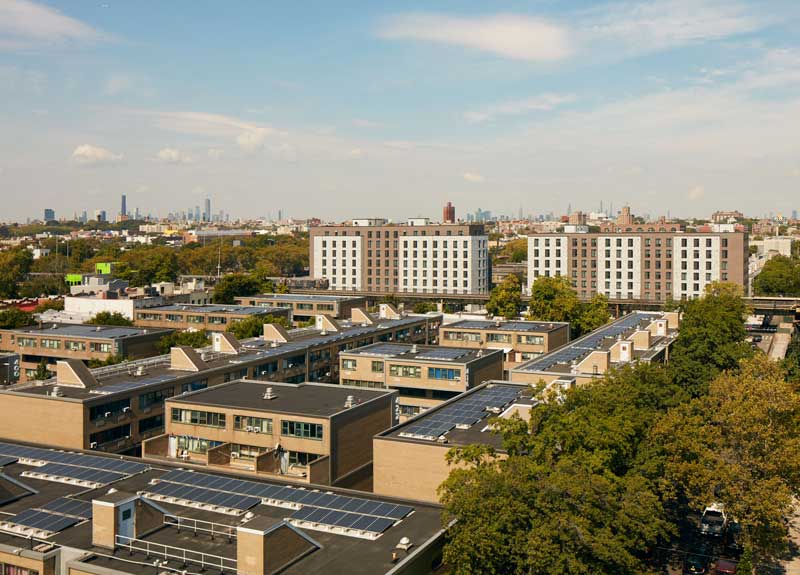
A recent example of all-electric new construction is Marcus Garvey Phase II project (Photo 1). Two new buildings that are fully electric with ground source heat pumps for heating, cooling, and hot water, electric stoves, and energy recovery ventilators for capturing exhaust energy. They have a well-insulated, tight envelope. (see photo 1)
Existing buildings are trickier and costly. It is harder to find space for heating and cooling systems and its associated infrastructure. It is also more difficult to drill for geothermal, unless there is a large site outside of the building footprint. Often, it requires an upgrade to the electric services to deal with the higher electric demand. For tenant in place renovations, these issues are compounded and cause quite a disruption for residents and logistics for the general contractor. A gas stove replacement with an electric stove may seem simple at first, but it can become costly and complicated if it triggers the need for a larger electrical panel and new wiring. When it comes to heating and cooling, PTHP systems are the simplest to install but may not be appropriate for historic buildings and require many holes in the façade, which can be tricky to manage. If using VRF or ground source heat pumps, ways to run the lines from either the roof or the cellar need to be determined.
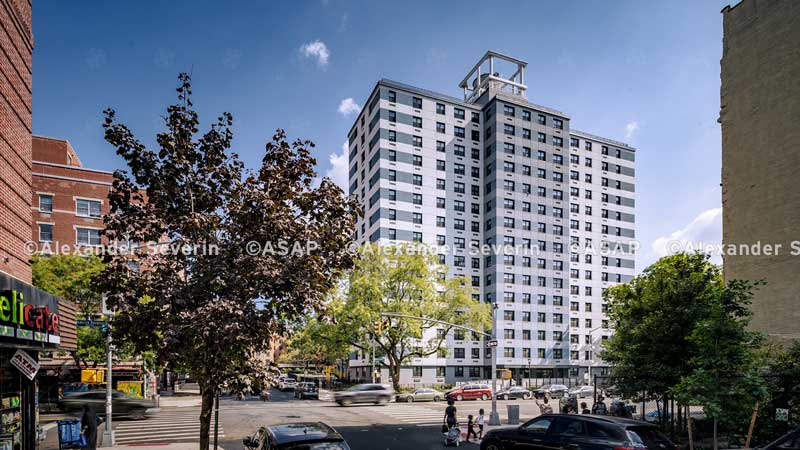
A major issue is how to improve the envelope on existing buildings. The best solution from an energy perspective is overcladding, where you wrap the existing façade in an insulated blanket. Often this is not possible; the existing building may be at a lot line and/or have historic value. One can then look at under-cladding, adding insulation to the interior of the exterior wall. This has been an issue that may expose existing material to the freeze-thaw cycle, which they were not designed for; it will likely lose habitable space and, at the slabs, there will still be thermal breaks. Window upgrades and adding roof insulation are easier to do to improve the envelope. ERV ventilation can be tricky; exhausts are typically already in a building but figuring out how to return the tempered fresh air can be hard. An example of a project is Harlem River II, a New York City Housing Authority Building, where we overclad the building with EIFS, replaced the windows with UPVC windows, and installed a new roof with additional insulation and PTHP units for heating and cooling. Stoves remained gas, because the authority had just replaced all of the gas lines, highlighting the importance for organizations to review their capital improvement plans and align them with their sustainability and resiliency plans. Hot water remained gas-fired, but given that it is a centralized system, it will be easier to replace in the future. (see photo 2)
To summarize, electrification is critical for our low-carbon future. It is relatively easy to do in new construction, as we have done in many buildings. It is trickier, but critical to do for existing buildings. In existing buildings, planning is critical, so if full electrification is not possible at one time, it is done incrementally over time.